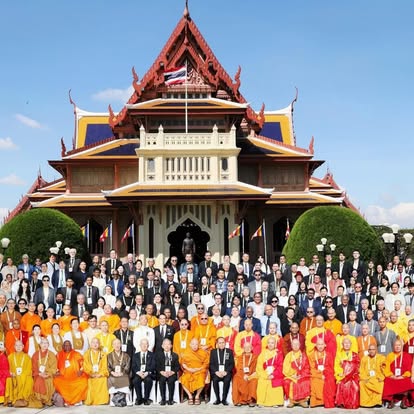
My post about the 10,000 monks in Thailand took an interesting turn, because after I posted it, I was talking with Bhante Mudita and he said, “You know this is Dhammakaya, right?” I had no idea.
Most people are familiar with the three broad traditions of Buddhism: Theravāda, Mahāyāna and Vajrayāna (aka Tibetan Buddhism). But the more I learn, the more I realize that Buddhism is less like three separate boxes and more like a huge family tree, with traditions developing out of earlier traditions, branching off, reforming and sometimes developing in very different directions.
For example, Vajrayāna developed within the broader Mahāyāna Buddhist world, retaining many Mahāyāna teachings while developing its own distinctive tantric practices. Something somewhat analogous happens within Thai Theravāda. The two major Thai monastic fraternities are the Mahā Nikāya and Dhammayuttika Nikāya, and there are many different lineages within these broader traditions.
Then there is Dhammakaya, which grew out of the Mahā Nikāya tradition but developed into a very distinctive modern Buddhist movement, with its own meditation practices, organizational structure, enormous gatherings and approach to merit-making. It has also been controversial and has had a complicated relationship with Thailand’s established Sangha and government.
I had never really appreciated just how many different schools, lineages and movements exist within Buddhism, and even within Theravāda itself. I can spend years studying the tradition I practice and still stumble across an entire Buddhist world that I knew almost nothing about.
The more traditions I encounter, the more I appreciate the importance of investigating for myself. What do they practice? What do they emphasize? What appears skillful? What do I question? What can I learn from their approach, even if ultimately it isn’t the path I choose?
For me, being a Buddhist monk isn’t about assuming that everything called Buddhism must be accepted, nor is it about dismissing traditions simply because they are unfamiliar. It’s about investigating, practicing, observing the results and continually examining what the Dhamma means in the way I choose to live this life.
Apparently, I thought I was looking at 10,000 monks receiving alms. Instead, I stumbled into a whole new branch of the Buddhist family tree that I didn’t even know existed.